

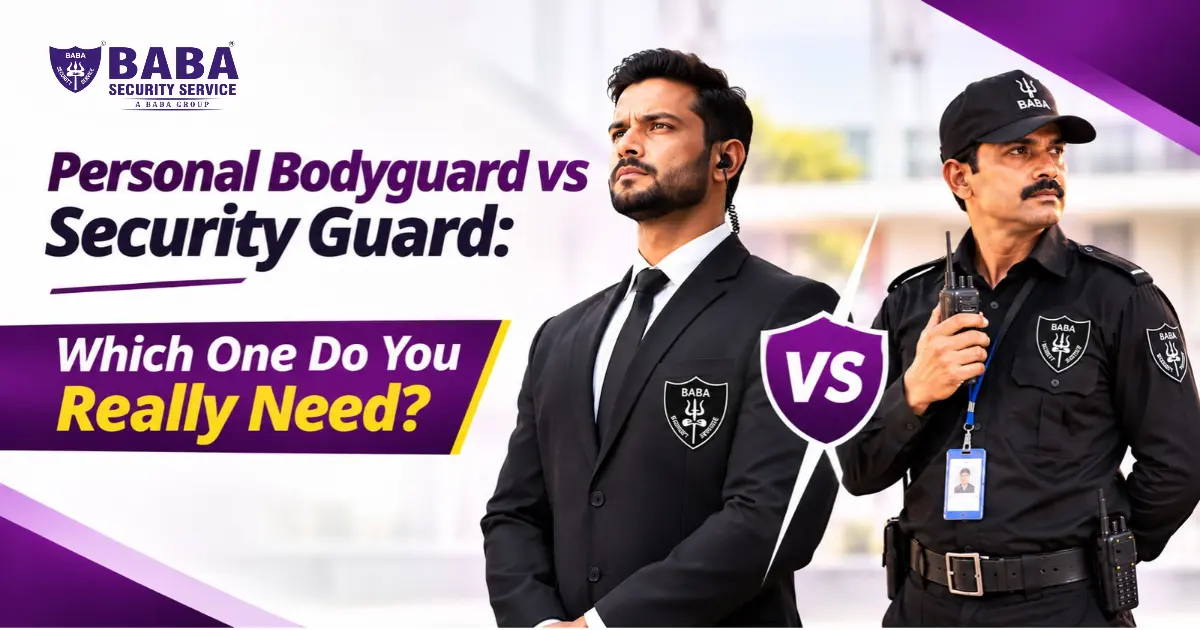
A security guard protects a property, such as an office, factory, school, bank or mall. A personal bodyguard protects a specific human being, wherever that person goes. If your risk is tied to a location, you need a guard. If your risk is tied to you, you need a bodyguard. In many cases a business needs both, but the starting point is always the same: where does the danger actually appear? Answering that one question will save you time and money.
Table of Contents
What Is a Security Guard?
A security guard is a trained professional who watches over a fixed site, controls who enters and leaves, and responds to problems like theft, trespassing or fire. They are usually the visible, reassuring presence at the gate or reception. Their presence alone discourages most petty crime, because people think twice before entering a guarded property. In India, guards are usually supplied by registered private security agencies that handle hiring, training and supervision.
Main Duties of a Security Guard
Guards manage entry and exit, check visitors, patrol the premises, monitor CCTV and write daily reports. They also follow the site’s standard rules and escalate any incident to the supervisor or the police. Their job is mostly about prevention through presence and discipline. A good guard is alert, polite and firm at the same time. Small habits, like noting every visitor and checking locks at closing time, prevent most security problems.
Where Security Guards Are Usually Deployed
You will find guards at banks, ATMs, factories, schools, malls, residential societies, hospitals and corporate offices. They are posted in shifts, so the site stays protected day and night. Because the location stays the same, the work follows a predictable routine. This makes it easier for an agency to train guards on the site’s specific rules and risks. Over time, a guard who knows the premises well becomes the best early-warning system the property has.
What Is a Personal Bodyguard?
A personal bodyguard, also called a close protection officer, is responsible for the physical safety of one individual or a small group. They stay close to the person, plan every movement in advance and watch for threats before they develop. The job is less about physical force and more about preparation, awareness and calm decision-making. A skilled bodyguard avoids trouble before it starts, which is why the best protection often goes unnoticed.
Core Responsibilities of a Bodyguard
A bodyguard studies the client’s daily schedule, checks venues and routes beforehand, and stays alert during travel and public appearances. They also protect the client’s privacy and handle crowds or sudden threats calmly. The goal is to prevent danger quietly, without drawing attention. This includes managing entry and exit points at venues, keeping a safe distance from unknown people and always having an escape plan ready. Every day’s schedule is treated like a mission that needs advance planning.
Who Usually Hires a Personal Bodyguard?
Business owners, senior executives, politicians, doctors, builders, public figures, wedding families and people facing threats or disputes often hire close protection. Some also hire a bodyguard only for a specific event or a short travel period. The need is personal, not property-based. A family may hire protection for a wedding with a large guest list, while an executive may need it only during business travel. Clear communication about the situation helps the provider design the right level of cover.
Personal Bodyguard vs. Security Guard: Key Differences
The two roles overlap in discipline and training, but they differ in purpose, skills and style of work. Here is a side-by-side view before we go deeper. Understanding these points will help you avoid hiring the wrong service. Each difference below affects both the quality of protection and the final cost.
| Factor | Security Guard | Personal Bodyguard |
|---|---|---|
| Protects | A place or property | A specific person or family |
| Movement | Stays at a fixed post | Travels with the client |
| Approach | Observe, control access, report | Anticipate, shield, evacuate |
| Planning | Site-level routine | Route, venue and schedule-level planning |
| Visibility | Usually visible and uniformed | Often discreet, in formal or plain clothes |
| Cost | Lower, shared across a site | Higher, because of one-to-one attention |
Who They Protect
A guard looks after everyone and everything inside a site. A bodyguard has one priority, which is the safety of the client. This difference in focus changes how each person is trained and how they behave on duty. A guard thinks about the whole site, including gates, parking areas and visitors. A bodyguard thinks about one person’s safety in every setting, from a car to a hotel lobby.
Training and Skills
Guards are trained in access control, patrolling, report writing, basic fire safety and emergency response. Bodyguards need all of that plus threat assessment, safe driving, route planning, crowd handling, first aid and strong communication skills. Close protection also demands excellent judgment and self-control. Training is not a one-time event for either role. Regular practice, refresher sessions and supervision keep skills sharp and help staff handle real situations calmly.
Working Style and Movement
A guard works from a post and follows a shift schedule. A bodyguard moves with the client, which means irregular hours, travel and quick decisions. This is why bodyguard work is more demanding and more expensive. A guard’s routine is stable, while a bodyguard must adapt to changing plans at short notice. That flexibility, along with the personal responsibility involved, is what clients pay for.
Threat Assessment and Planning
A guard usually works with a site-level risk plan. A bodyguard builds a personal risk profile, including daily routines, known threats, travel patterns and public exposure. Good close protection starts long before the client steps outside. Before any assignment, a professional team studies the places the client will visit and the people likely to be present. This early planning often removes risks that would be hard to manage on the spot.
Discretion and Professional Conduct
Both roles need discipline, but bodyguards handle far more private information. They see the client’s home, family, meetings and movements. This is why confidentiality and background verification matter so much in personal protection. A trustworthy bodyguard never shares details about the client’s movements or family life. Always ask whether the agency has a written confidentiality policy for its staff.
When Do You Need a Security Guard?
Choose a security guard when you want to protect a place, stock, equipment or staff and visitors inside a premises. This is the right fit for most offices, shops, factories, schools and housing societies. A well-trained guard team gives staff and visitors a sense of safety and helps the business run without worry. For most organisations, a properly planned guard service is the most practical first step.
For offices, factories, banks and educational campuses, explore our Corporate Security Services designed around your premises and risk level.
Signs a Guard Service Is Enough
If your concerns are theft, unauthorised entry, vandalism or poor access control, a guard service solves the problem. You mainly need discipline at the gate and regular patrolling. There is no specific threat against a particular person. If you are not facing personal threats, spending on a bodyguard is usually unnecessary. A better investment is trained guards, good lighting and a clear visitor policy.
Services That Fit Best
Corporate security, industrial and factory guarding, bank and ATM security, school security and objects protection are the usual choices. These services focus on keeping assets safe and operations smooth. They are also the most cost-effective way to secure a business. You can combine these services based on your site, such as corporate security along with objects protection. A short site visit helps decide how many guards you need and where to place them.
When Do You Need a Personal Bodyguard?
Choose a bodyguard when the risk follows you, not the building. If you face threats, handle large cash, travel often or attend high-profile events, a guard at the gate will not be enough. If you feel unsafe outside your home or office, that is a clear sign to take close protection seriously. Waiting until something happens is the most expensive way to learn this lesson.
Situations That Call for Close Protection
Common situations include business disputes, threats or stalking, high-value travel, public events, political activity and family functions with large crowds. In each case, the danger can appear anywhere. Only someone beside you can respond in time. In such cases, the protection must be planned around your routine, not around a building. The earlier this planning starts, the more effective it becomes.
Short-Term vs. Long-Term Protection
Some clients need a bodyguard only for a wedding, a roadshow or a business trip. Others need a full-time protection officer. A good provider will assess your situation first and recommend the right level, not the biggest package. Starting with a short-term arrangement is also a smart way to test the provider’s professionalism. You can then extend or reduce the service based on actual needs.
Can You Use Both Together?
Yes, and many clients do. A site guard protects the office or home, while a bodyguard protects the person during travel and public activity. Together they create layered security with no gaps. Layered protection is how professional security plans are built, because no single person can cover every risk. When guards and bodyguards coordinate, information flows better and response is faster.
Example of Layered Security
Imagine a business owner with a factory and a daily commute. Guards control access at the factory gate, and a bodyguard accompanies the owner between home, office and meetings. Each layer covers what the other cannot. If the owner’s travel plan changes, the bodyguard informs the guard supervisor so the gate team is ready. This kind of coordination is what separates a planned service from a random one.
Legal Side: What to Know Before You Hire in India
Private security in India is regulated, so the legal status of your provider matters. Hiring an unlicensed agency can create legal and safety problems for you. Checking the paperwork takes only a few minutes but can protect you from serious trouble later. A genuine provider will welcome these questions.
Check for PSARA Licensing
Private security agencies in India operate under the Private Security Agencies (Regulation) Act, 2005, known as PSARA. Always ask for the agency’s licence from the state authority and verify it. A genuine agency will share it openly. Make sure the licence is valid and covers the area where you need the service. If an agency avoids showing documents, treat that as a warning sign.
Verification and Background Screening
Good agencies verify their guards and bodyguards before deployment, including identity, address and police background checks. This is especially important for close protection, because the person will be near you and your family. Ask what verification process the agency follows. A professional agency keeps proper records for each person it deploys. This protects both you and the agency if any question ever arises.
Rules About Arms
Carrying firearms is governed by separate arms laws and licences. Most guard and bodyguard services run on an unarmed basis unless proper authorisation exists. Never accept a provider who casually promises weapons without legal paperwork. Professional protection relies far more on training, awareness and planning than on weapons. If you believe armed cover is necessary, consult the agency and follow the proper legal process.
How to Choose the Right Security Provider
The provider you pick matters as much as the service type. A well-trained team with clear processes will always outperform a cheap, unverified one. Take time to compare providers on training, supervision and honesty, not only on price. The right choice should make you feel confident from the very first conversation. For a detailed checklist, read our earlier guide on how to choose a security service company.
A Simple Checklist Before You Hire
- Valid PSARA licence and company registration
- Verified, trained and uniformed personnel
- Clear contract with duty hours, replacements and escalation process
- Supervisor visits and daily or weekly reporting
- Honest risk assessment before quoting a price
- References or client reviews you can actually check
Questions to Ask the Agency
Ask how they train their staff, how fast they can replace an absent guard and how they handle emergencies. For bodyguard services, ask about route planning and confidentiality practices. Clear, confident answers are a good sign. Vague or rushed answers usually mean the agency lacks proper systems. Take your time, compare two or three providers and choose the one that explains things clearly.
How Much Do Guard and Bodyguard Services Cost?
Pricing depends on your requirements, so any fixed rate quoted without understanding your situation should be treated carefully. Guard services are usually priced per person per month, while bodyguard services are priced by duty hours, risk level and duration. Because every site and client is different, a fair quote always follows a requirement discussion. Ask for a written breakup so you know exactly what is included.
Factors That Affect the Price
The number of personnel, shift length, location, training level, risk level, vehicle needs and contract duration all change the cost. Round-the-clock coverage costs more than a single day shift. A short event cover is priced differently from a long-term assignment. Extra needs like uniforms, supervisors, trained drivers or specialised staff can also change the total. Share your complete requirement upfront to avoid surprise charges later.
Why the Cheapest Option Can Cost More
Very low prices often mean untrained staff, no verification or irregular salaries, which leads to poor performance. A single security failure can cost far more than the money you saved. Pay for reliability, not just a low number. A slightly higher price that includes training, supervision and replacements is usually better value. Think of security as protection for your business and family, not as an ordinary expense.
Common Mistakes People Make When Choosing Security
Most security problems come from wrong decisions at the beginning, not from bad luck. Avoiding these mistakes will save you money and stress. Most of them come from rushing the decision or choosing only on price. A little research before signing a contract goes a long way.
Mistake 1: Hiring a Guard When You Need a Bodyguard
A gate guard cannot protect you in a car, at a hotel or at a public function. If the threat is personal, the solution must be personal too. Match the service to the actual risk. If you are unsure, describe your daily routine and concerns to the security provider and let them guide you. A good agency will tell you honestly if a guard is enough.
Mistake 2: Skipping the Risk Assessment
Many buyers jump to price without understanding their vulnerabilities. A short security consultation can show weak points you never noticed, such as an unmonitored entrance or a predictable daily route. It often reduces the final cost too. Knowing your real risks helps you avoid paying for protection you do not need. It also makes sure the money you spend goes where it matters most.
Mistake 3: Ignoring Verification
Even the best-looking uniform means little without background checks. Always confirm how staff are screened before they start working. Trust should be backed by process. Ask to see how the agency checks identity and past records, and how often staff are reviewed. These simple questions reveal how seriously the provider takes your safety.
Why Choose Baba Security Service?
Baba Security Service in india offers a complete range of protection services under one roof, so you do not need to deal with multiple vendors. Our approach is simple: understand your risk first, then recommend the right solution. This means you are never pushed into services you do not need. Every plan is built around your premises, your people and your budget.
Learn more about us on the Baba Security Service home page, or see how our trained teams protect businesses through our Corporate Security Services.
Our Services at a Glance
We provide Security Consulting, Personal Protection, Corporate Security, Objects Protection, Background Screening and Investigation support. Whether you need a guard for your premises or a bodyguard for yourself, our team can plan it for you. Services are available across Uttar Pradesh. Each service can be used on its own or combined into one security plan. Our team is happy to explain how they fit together for your situation.
What Makes Us Different
We focus on trained and verified personnel, clear communication, confidentiality and quick response. Our team starts with a risk review and builds the deployment around your needs. Our goal is long-term trust, not one-time contracts. We believe good security is built through consistency, honest communication and quick action when it matters. That belief guides how we plan and manage every assignment.
Looking for reliable personal security? Explore our professional Personal Protection & Bodyguard Services for VIPs, business executives and individuals.
Faqs
What is the main difference between a bodyguard and a security guard?
A security guard protects a fixed property, while a bodyguard protects a person wherever they go. Bodyguards also require extra skills like threat assessment, route planning and close protection tactics.
Is a bodyguard more expensive than a security guard?
Usually yes, because a bodyguard provides one-to-one protection, flexible hours and a higher level of training. A guard’s cost is spread across a site, which keeps it lower.
Do I need a licence to hire a bodyguard in India?
You do not need a licence to hire protection, but the agency you hire from should hold a valid PSARA licence. Carrying firearms needs separate legal permission, so confirm this before any deployment.
Can one person act as both a guard and a bodyguard?
The roles are different, and mixing them reduces effectiveness. A guard focuses on the premises, while a bodyguard stays with the client. For full coverage, use both roles with the right people.
How do I know which service is right for me?
Start by asking whether the risk is tied to a place or to you. A short consultation with a security expert can confirm this and suggest the right plan.
Pingback: How to Choose the Best Security Service Company in India: A Complete Guide for Businesses - Baba Security